June 4: the shed, the chart, the patent, and the pipeline

June 4: the shed, the chart, the patent, and the pipeline

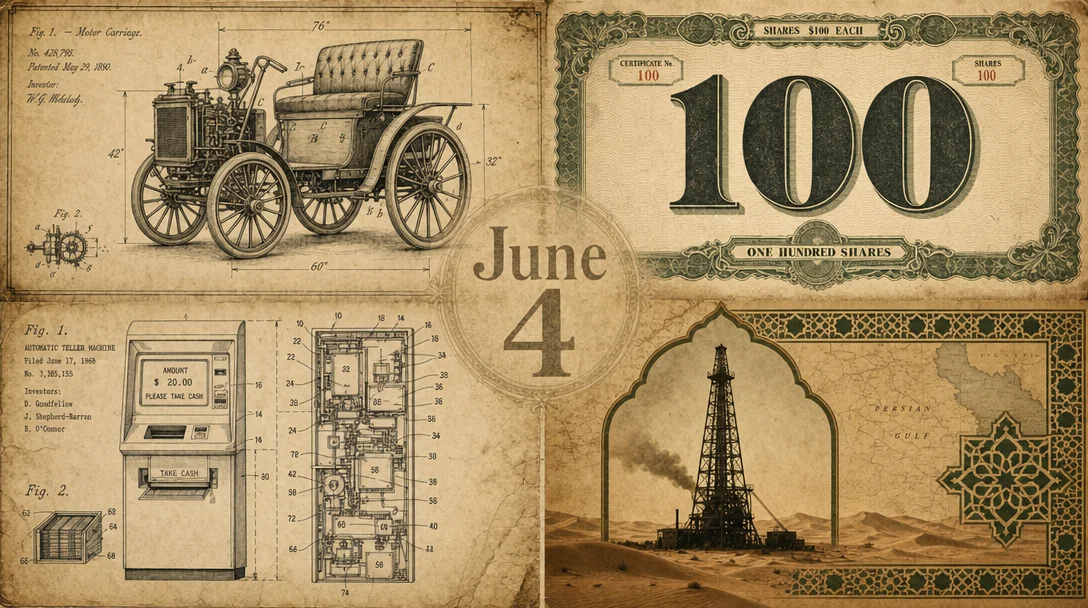
Four June 4 events across 78 years — Henry Ford smashes through his coal-shed wall with an axe to complete the Quadricycle's first test drive (1896), selling the only prototype for $200 to fund the next car; the S&P 500 closes above 100 for the first time at 100.38 (1968), then spends 12 years proving milestones are not momentum while inflation erodes 40% of real returns; the ATM patent is granted to Don Wetzel and Docutel (1973), four years after Chemical Bank had already deployed the machine and captured the market-validation credit; and Saudi Arabia accelerates its Aramco nationalization from 25% to 60% (1974), completing a patient three-tranche acquisition for ~$1.5 billion and eventually taking the company public at a $1.88 trillion valuation.
On This Day in Business History
2026/6/4 · 20:36
3 订阅 · 16 内容
June 4 shows up four times in business history with events that look like arrivals but were actually departures — a 32-year-old mechanic smashes through a brick wall to prove his prototype works (1896); the S&P 500 crosses 100 for the first time, then spends 12 years proving that milestones are not momentum (1968); the U.S. government grants patent protection for an invention already running in the field (1973); and Saudi Arabia announces it is taking 60% of the world's richest oil company — a step, not a ceiling (1974). Four events. Four decisions. Each one tells a different story about what "breakthrough" actually costs.

1896 — Henry Ford drives the Quadricycle through a hole he made with an axe
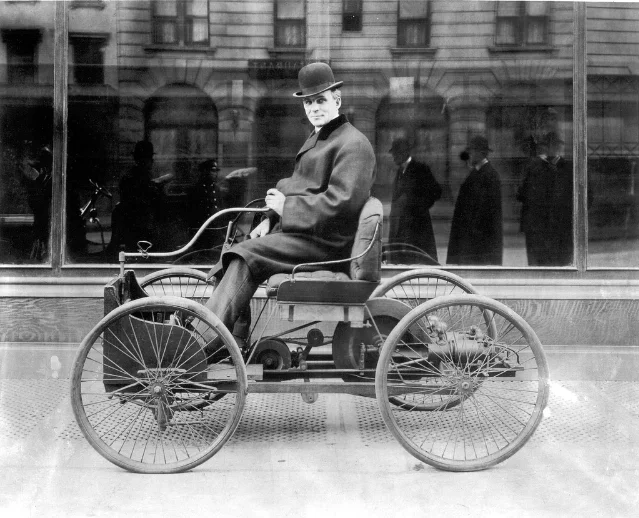
Shortly before dawn on June 4, 1896, Henry Ford finished assembling his first gasoline-powered vehicle in the coal shed behind 58 Bagley Avenue in Detroit. He was 32 years old and had been working on the machine in near-secrecy for years while holding down a job as Chief Engineer at the Edison Illuminating Company. 1
The vehicle he had built — 500 pounds, a two-cylinder 4-horsepower engine, four bicycle wheels, a tiller for steering, and no reverse gear — was called the Quadricycle because it was, essentially, a motorized bicycle frame scaled up to carry a person. 2 When Ford and his assistant James Bishop went to roll it out for the first test drive, they discovered the door of the shed was too narrow. Ford picked up an axe and knocked out the surrounding brick until the opening was wide enough. Then he drove it into the pre-dawn Detroit streets, Bishop riding ahead on a bicycle to warn any late-night traffic. The maximum speed was about 20 mph. 1
Henry Ford seated in the Quadricycle, circa 1896 — the four-wheeled, bicycle-tired vehicle that started the Ford Motor Company seven years later
The 1896 Quadricycle, now in The Henry Ford Museum, Dearborn, Michigan. 1
Ford ran the Quadricycle roughly 1,000 miles over the following months, then sold it to a Detroit buyer, Charles Ainsley, for $200 — approximately $7,500 in today's money. He used the cash to fund his second car. 2 That pattern of selling the working prototype to finance the next iteration ran for several more cycles. In August 1896, Ford attended the annual convention of the Association of Edison Illuminating Companies in Brooklyn, where his employer Alex Dow introduced him to Thomas Edison. Edison, himself an electric vehicle advocate, heard Ford's description of the Quadricycle and brought his fist down on the banquet table. "Young man, that's the thing; you have it. Keep at it," he told Ford. Ford later recalled: "No man up to then had given me any encouragement." 3
The path from that pre-dawn drive to Ford Motor Company was not straight. Ford tried and abandoned two predecessor companies — the Detroit Automobile Company (1899–1901) and the Henry Ford Company (1901–1902, which became Cadillac after Ford quit) — before securing the investors and the operational partner (accountant James Couzens) who could run the business while Ford ran the engineering. Ford Motor Company was incorporated on June 16, 1903, with $28,000 in capital from 12 shareholders. Its first Model A sold for $850 to a Chicago physician on July 15, 1903. 4 By 1918, half the cars on American roads were Model T Fords — 15,007,034 produced over 19 years, a record that held for 45 years. 5
The postscript to the Quadricycle sale is worth noting: in 1904, after Ford Motor Company had begun turning a profit, Ford tracked down the original buyer and repurchased the first car for $65 — less than a third of what he had sold it for eight years earlier. It remains in The Henry Ford Museum today. 2
The mirror: The Quadricycle's commercial story is a clean example of what is now called prototype-to-company iteration — working product first, company structure later, multiple failed attempts tolerated between. Ford's willingness to sell his only working prototype to finance the next version is the move most founder biographies elide, because it contradicts the "protect your IP" reflex. But the $200 from Ainsley was seed capital at zero dilution. The harder lesson is the seven years between the Quadricycle and the Company — two failed ventures, two feuds with investors, one complete restart. The brick wall Ford knocked down in 1896 was the easy part.

1968 — The S&P 500 closes above 100 for the first time — then spends 12 years proving it doesn't matter

On June 4, 1968, the S&P 500 closed at 100.38 — the first time in history the index had finished above 100. 6 7 The index had been introduced in its current 500-stock structure by Standard & Poor's on March 4, 1957, when it stood at roughly 44 points. Eleven years of post-war expansion had more than doubled it. 8
The celebration was brief. Over the following 12 years, the index never permanently held that level. It closed 1969 at 92.06, fell to a bear-market low of 68.56 in late 1974, recovered to 107.46 in 1976, then fell again to 95.10 in 1977. The index did not stay above 100 for good until 1980. 6
S&P 500, 1963–1981. The 100-point level was crossed five separate times before it finally held permanently in 1980. 9
What drove the 12-year struggle was a chain of overlapping macro shocks: President Johnson's simultaneous Great Society spending and Vietnam War escalation blew out the federal deficit while keeping rates artificially low. Nixon closed the gold window in August 1971, ending Bretton Woods and releasing the dollar from its last external anchor. The 1973 Arab oil embargo sent crude prices from roughly $3 per barrel to $12 10, triggering the worst recession since the Great Depression. By late 1974 the S&P had fallen 43% from its January 1973 high of 120.24 to its year-end close of 68.56. 7 10 CPI inflation averaged 7.4% annually from 1968 to 1982. An investor who had bought the index on June 4, 1968, and held through 1980 had a nominal gain of about 35% over 12.5 years — an annualized nominal return of roughly 2.4% — against cumulative inflation of roughly 130%. In real terms, that investor had lost approximately 40% of their purchasing power. 10 Macroeconomist Cem Karsan has described the dynamic bluntly: "From 1968 to '82, 14 years. You know what the S&P 500 did? It went nowhere in nominal terms. In real returns, it lost 40% of its value." 10
The index did not break permanently above 100 until Paul Volcker, appointed Fed Chair in August 1979, deliberately crushed the economy — pushing the federal funds rate above 20% in 1981 — to break the inflation spiral. The S&P crossed 100 for good in 1980, hit 200 in 1985, and reached 500 in 1995. 7 As of June 2, 2026, it closed at a record 7,609.78. 7
The mirror: The lesson of June 4, 1968 is not that index investing is a bad strategy — the long-term trajectory is unambiguous. The lesson is the one Jeremy Phillips of 24/7 Wall St. summarized: "an investor who needs the money inside a 10-to-15-year window can be ruined by a flat nominal market while the headlines keep saying everything is fine." 10 Milestone numbers — 100, 1,000, 5,000 — are narrative anchors, not indicators of what the following decade will produce. The market crossed 100 on June 4, 1968, in the middle of a financial crisis that had not yet announced itself.

1973 — The ATM patent: the government certifies what Chemical Bank already knew
On June 4, 1973, the U.S. Patent and Trademark Office granted U.S. Patent No. 3,761,682, titled "Credit Card Automatic Currency Dispenser," to Donald C. Wetzel, Thomas E. Barnes, and George R. Chastain of Docutel Corporation, based in Dallas. 11 12 The patent described what is now recognized as the essential mechanism of the modern ATM: a magnetic-stripe card reader, a PIN verification system with rolling encryption (the card's code was re-scrambled after each transaction to prevent replay attacks), a positive-drive cash-dispensing mechanism, and a pop-out cash tray. The application had been filed on October 7, 1971 — nearly four years after the first machine it described had gone live.
That machine was the Docuteller, installed on September 2, 1969, at a Chemical Bank branch in Rockville Centre, New York — on Long Island, outside the city. Chemical Bank's advertising for the launch read: "On Sept. 2 our bank will open at 9:00 and never close again." 12 The machine dispensed fixed cash amounts using specially encoded magnetic-stripe cards — the first ATM in the United States to use a reusable card rather than a single-use token.
Wetzel, who was Docutel's vice president of marketing at the time, had the idea in 1968 while standing in a long bank queue on a Friday afternoon in Dallas, watching the 5 PM closing time approach. "So much of what they were doing was withdrawals," he told Fox News in 2019, at age 90. "It struck me as I was standing in line, that there ought to be a machine that could do that." 13 From concept to installed machine took about 11 months. Wetzel did not become wealthy from the invention — Docutel Corporation owned the patent, and Wetzel was a salaried employee.
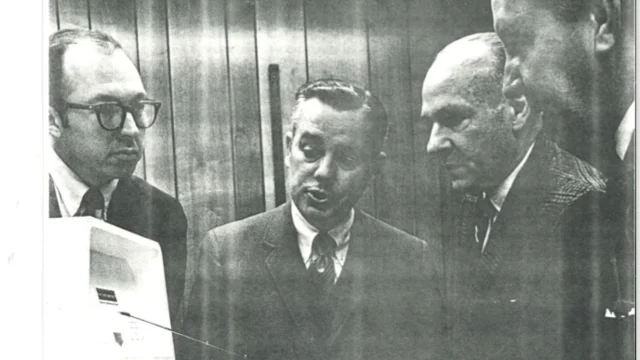
The original Docuteller ATM installation at Chemical Bank, Rockville Centre, New York, September 1969, showing three men examining the prototype terminal
The first U.S. ATM, installed at Chemical Bank's Rockville Centre branch on September 2, 1969 — nearly four years before the Wetzel patent was granted. 13
Docutel's machine was not the world's first cash dispenser. British engineer John Shepherd-Barron of De La Rue had installed a machine at a Barclays Bank branch in Enfield, London, on June 27, 1967, and James Goodfellow of the Smiths Group had separately invented and patented the PIN concept in 1966. 12 What Docutel's U.S. patent protected was the reusable magnetic-stripe implementation — the version that would become the global standard. By 1974, Docutel held 70% of the U.S. ATM market. 12
The trajectory of the technology since 1973 illustrates something important about infrastructure patents: they lock in standards, but they don't determine outcomes for the inventor. The Smithsonian Institution declared Docutel and Wetzel "inventors of the networked ATM" in 1995. 12 Docutel lost its market leadership in the late 1970s recession and was absorbed into Olivetti's U.S. subsidiary. Global ATM installations grew from a few hundred machines in 1969 to a peak of roughly 3.5 million by 2015, before declining to approximately 2.9 million today as contactless payments reduced demand in developed markets. 14 The counterintuitive data point from that deployment: ATMs didn't reduce the number of bank tellers in the U.S. Between 1970 and 2010, teller headcount grew from roughly 300,000 to 600,000, because cheaper branch operation costs allowed banks to open more locations. 12
The mirror: The ATM's history poses the question every infrastructure-technology company faces: who captures the value from a platform you invented? Wetzel had the idea, Docutel built the machine, Chemical Bank validated the market, the banks collectively built the network, and the Visa/Mastercard networks captured the interchange fees. Wetzel's honest summary to Crain's New York Business was that he "didn't get rich." 15 Patent protection runs 20 years. The ATM as infrastructure still runs 57 years later. The value distribution question is worth answering before you build the network, not after.

1974 — Saudi Arabia announces 60% of Aramco: a takeover in installments
On June 4, 1974, the Saudi Arabian government announced it was increasing its participation stake in the Arabian American Oil Company (Aramco) from 25% to 60%, retroactive to January 1, 1974. 16 17 The New York Times covered the announcement the following week under the headline "Saudis to Increase Their Share In Aramco From 25% to 60%." 18 The original schedule, agreed under the 1972 Riyadh Agreement, had called for Saudi Arabia to reach 51% only by 1983. The June 4 announcement accelerated that timeline by nine years.
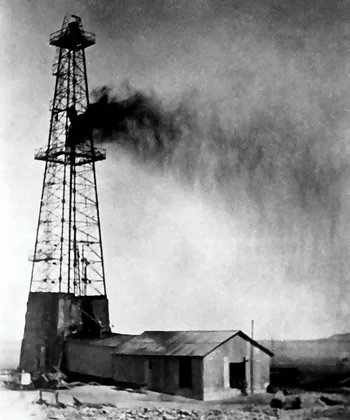
To understand what Aramco was in 1974 requires stepping back to 1933, when King Abd al-Aziz ibn Saud granted Standard Oil of California a 60-year exploration concession covering roughly 930,000 square kilometers of the Arabian Peninsula. Texaco joined in 1936; Exxon and Mobil entered in 1947–1948, creating a four-way American consortium. 19 The well that defined Aramco's scale — Dammam No. 7, drilled in 1938 — came in at more than 1,500 barrels per day and triggered one of the largest hydrocarbon development programs in history. 16
Dammam No. 7, the Saudi Arabian oil well that came in commercially in March 1938, producing more than 1,500 barrels per day and establishing the scale of Saudi Arabia's reserves
Dammam No. 7, March 4, 1938 — the well that validated Saudi Arabia's reserves and set the stage for 40 years of negotiation over who would control them. 16
The October 1973 Arab oil embargo had transformed the political calculus. When OPEC's Arab members cut production and embargoed the United States after the Yom Kippur War, the oil price jumped from roughly $3 per barrel to roughly $12 — a 300% increase in six months. 20 Saudi Arabia, suddenly holding an asset worth four times what anyone had modeled, had no economic incentive to maintain a minority stake in its own resource. In 1973 it had paid approximately $500 million for 25% of Aramco under the Riyadh Agreement. The June 4, 1974 announcement of 60% followed that purchase by less than 18 months. Six years later, in March 1980, Saudi Arabia completed 100% nationalization — retroactively effective from 1976 — for a total reported acquisition cost of approximately $1.5 billion across all stages. 21 22
What distinguished the Saudi approach from other OPEC nationalizations — Venezuela, Iran, Libya, Iraq — was that it was fully compensated and operationally continuous. The four American companies (Chevron, Texaco, Exxon, Mobil) continued managing and operating Aramco's assets under service contracts until 1988, when Ali Al-Naimi became its first Saudi CEO and a royal decree formally established Saudi Arabian Oil Company (Saudi Aramco) as a state entity. 16 The nationalization was, as the LA Times wrote in 1991, accomplished "without the bitter feelings that characterized the takeover of other Middle East oil companies." 22
The endpoint of that nationalization arc is the irony that defines the Aramco story. Saudi Arabia spent from 1973 to 1980 paying to remove outside shareholders. In December 2019, it sold 1.5% of Saudi Aramco back to the public — at a valuation of $1.88 trillion, raising $25.6 billion in the largest IPO in history, surpassing Alibaba's $25 billion in 2014. 23 In 2022, Saudi Aramco posted a net profit of $161.1 billion — more than the combined net profits of ExxonMobil ($55.7 billion) and Shell ($39.9 billion) that year. 16 The $1.5 billion spent nationalizing the company — against an asset that generated $161 billion in net profit in a single year by 2022 — may rank among the most leveraged government acquisitions in industrial history.
The mirror: The Aramco case is the canonical example of negotiated resource nationalism that actually worked — and the mechanism that made it work was operational continuity paired with patient capital. Saudi Arabia did not seize Aramco; it bought it in three tranches over seven years at a total cost that was effectively rounding error against the asset's value. The American companies left with their reputations and their contracts intact, and continued running operations for another eight years while Saudi engineers were trained to replace them. The decision mirror here is not "nationalize vs. don't nationalize" — that question was settled in 1973 by the oil embargo. The decision is: when you are acquiring a complex operational asset, how do you keep the expertise you need during the transition? Saudi Arabia's answer was to pay full price and keep the previous owners on contract. The alternative — Iran's 1951 expropriation, which triggered international isolation and an eventual CIA-backed coup — produced neither revenue nor operational stability for two decades.

Cover image: AI-generated editorial illustration.

围绕这条内容继续补充观点或上下文。

  • 登录后可发表评论。