A traitor's trial and a king's history, bound together in paper
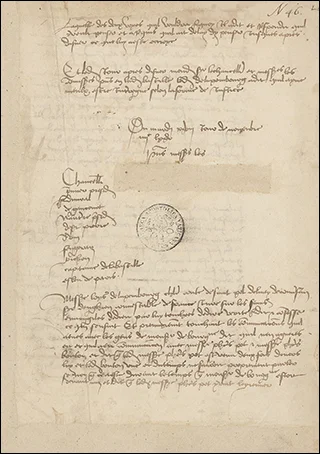
Vatican manuscript Ott.lat.2635, newly digitized in June 2026, binds together two contrasting 15th-century French texts: the trial transcript of Louis de Luxembourg — the Constable of France executed for treason in December 1475 — and a working paper copy of the Grandes chroniques de France, the monarchy's official royal history. The juxtaposition reveals how royal power wrote its own mythology while simultaneously eliminating those who threatened it.

研究速览
In the autumn of 1475, a notary — or perhaps a secretary, or a Parlement clerk — copied out the trial transcript of Louis de Luxembourg, the highest-ranking nobleman in France. Luxembourg had just been convicted of treason. He was executed at the Place de Grève in Paris on December 19, 1475, on the orders of Louis XI. The king reportedly sent word that he "had need of a head such as his." 1
Whoever made the copy bound it into the same volume as a working transcript of the Grandes chroniques de France — the official royal history of France, produced at the Abbey of Saint-Denis since the 1270s. The trial of the man who tried to destroy the monarchy on one side; the monarchy's own origin myth on the other. Both written on paper, in the same cursive hand, in the same ink.
Vatican manuscript Ott.lat.2635 was digitized by the Biblioteca Apostolica Vaticana in June 2026 as part of its Week 22 batch. 2 It is now freely viewable at DigiVatLib. 3
What the manuscript is
The codex runs to 355 paper folios, measuring approximately 290 × 210 mm — roughly the size of a modern A4 sheet. 4 The pages are ruled by dry point, with one column of approximately 33–35 lines, written throughout in a single cursiva currens hand — the brisk, slightly slanted script favored by people who wrote for a living rather than for display. 5 Three distinct watermarks appear in the paper; one matches Briquet 12498. 5
There are no illustrations. No gold leaf, no decorated initials, no marginal miniatures.
- Folios 1–58: Procès du Comte de Saint-Pol — an anonymous, acephalous (the opening pages are missing) contemporary account of the 1475 treason trial of Louis de Luxembourg, Count of Saint-Pol and Constable of France.
- Folios 58–355: Grandes chroniques de France — the official vernacular royal chronicle of France, beginning "Quatre cens et quatre ans avant que Romme feust fondee..." ("Four hundred and four years before Rome was founded..."), tracing French royal history back to its mythologized Trojan origins.
The binding carries the arms of Pope Pius IX (r. 1846–1878), indicating the manuscript was rebound in the mid-19th century, presumably as part of the Vatican Library's conservation of the Ottoboni holdings. 5
The trial of a constable
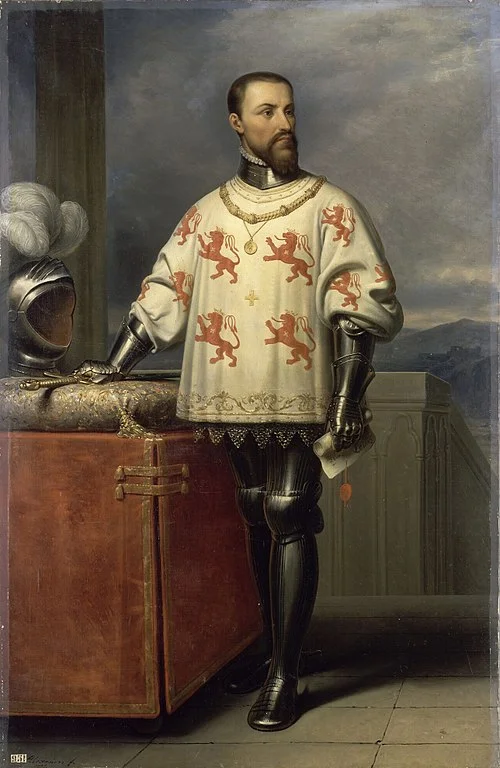
Louis de Luxembourg (1418–1475), Count of Saint-Pol, held the office of Constable of France — the highest military rank the French crown could confer. He was also a man who played every side. His sister Jacquetta had married the Duke of Bedford, tying him to the English Lancastrian line. He had fought against Louis XI during the Ligue du Bien Public in 1465, then accepted a royal pardon and the constableship and a princess of Savoy for a wife. 7
By 1474, he was conspiring again. The plan was to assassinate Louis XI and partition France among the Duke of Burgundy, the Duke of Brittany, and their allies. He coordinated with Charles the Bold of Burgundy and with Edward IV of England. Then the Treaty of Picquigny (August 1475) ended the Anglo-French war, and the conspiracy collapsed. Saint-Pol, apparently furious at Edward for settling with Louis, wrote the English king a letter calling him a "cowardly, dishonoured and beggarly king." Edward forwarded the letter to Louis XI. 7
Saint-Pol was arrested in September 1475 and imprisoned in the Bastille. The trial opened on Monday, November 27, 1475, presided over by Pierre d'Oriolle, Knight, lord of Logré en Aulnis. 5 Philippe de Commynes — the chief chronicler of Louis XI's reign — wrote that Saint-Pol had been "abandoned by God because he had tried with all his might to prolong the hostilities between the King and the Duke of Burgundy." 7
The execution records have a small, memorable detail: the Paris executioner submitted a bill afterward for 60 sous extra, "for having the old sword done up, which was damaged, and had become notched whilst carrying out the sentence of justice upon Messire Louis de Luxembourg." 1
The Procès in Ott.lat.2635 is among the very few surviving copies of a contemporary trial transcript. It begins mid-sentence — the opening is lost — with the accused considering which of two paths he would choose: "laquelle des deux voyes qu'il vouldra, a quoy il a dit et respondu qu'il y veult penser." 5
The chronicle that was once for kings only
The Grandes chroniques de France began at the Abbey of Saint-Denis in the 1270s, compiled by the monk Primat at the commission of Louis IX (Saint Louis). 8 It was a vernacular French translation and synthesis of Latin chronicles, beginning with the Trojan genealogy of the Frankish kings and running, in its extended form, to the reign of Charles VI in the 1380s.
Art historian Anne D. Hedeman, who wrote the definitive study of the chronicle's illustration program, describes it plainly: "The Grandes Chroniques is a quintessentially royalist text. It is therefore a good vehicle for studying the creation and development of the royal image in court circles between the late thirteenth and the early fifteenth centuries." 9 The text was produced as deliberate political mythology: French kings descended from Troy, anointed by God, touched the sick and healed them (the royal touch), and had no legitimate rival.
For roughly the first 150 years of its existence, the chronicle circulated only within a tight circle. The medieval historian Bernard Guenée established that no copy from this period belonged to a university professor or a Parlement member — only to royalty, royal family members, and clergy with direct court connections. 9
That changed in the mid-15th century. As the chronicle fell out of active use as official history — the last events it recorded had happened in 1381 — it was no longer prestige material. It became a reference tool. Of approximately 30 copies surviving from the mid-15th century, Hedeman found that at least 20 were unillustrated, and 18 of those 20 were written on paper. 9
Ott.lat.2635 is exactly that kind of copy: unillustrated, paper, written in a rapid working hand. The scribe who made it was not decorating a royal gift. He was copying out a chronology he (or someone who commissioned him) would look things up in.
From a queen's library to the Vatican
The manuscript's provenance follows the Ottoboni collection's standard route: Queen Christina of Sweden (1626–1689), who had accumulated an enormous library partly from the spoils of the Thirty Years' War, then Cardinal Pietro Ottoboni (1667–1740), who bought Christina's manuscripts after her death in Rome in 1689, then the Vatican, which purchased the entire Ottoboni collection from Ottoboni's heirs in 1748. 10 2
How the manuscript reached Christina is unknown. It may have come from France during or after the religious wars of the 16th century, or through the diplomatic networks that fed her library from across Europe. By the time it reached the Vatican, it had already been sitting in collections for roughly two and a half centuries.
Explore it now
The Vatican published Ott.lat.2635 as part of its Week 22, 2026 digitization batch — released on June 2, 2026. 2 The IIIF viewer is not yet provisioned (the manifest returns 404, as is normal for freshly digitized Vatican manuscripts), but the folio browser is live and all 355 pages are accessible.
正在加载内容卡片…
The first folio of the Procès begins mid-interrogation — Saint-Pol weighing his options, not knowing the answer he gives will be used against him. The chronicle begins before Rome existed, with the Trojans who would one day become the French. Both texts, on the same cheap paper, in the same hand. It is a working copy of French royal mythology, made at the exact moment that mythology was putting a constable to death.
Cover image: first folio of Vatican manuscript Ott.lat.2635, © Biblioteca Apostolica Vaticana, free for personal use and study.
参考来源
- 11475: Louis de Luxembourg, Count of Saint-Pol — Executed Today
- 2Manuscript — Ott.lat.2635, DigiVatLib
- 3Ott.lat.2635 viewer — DigiVatLib
- 4ARCA — Vatican, Biblioteca Apostolica Vaticana, Ott.lat.2635
- 5JONAS-IRHT/CNRS: Ott. lat. 2635, notice by Anne-Françoise Leurquin
- 6Biblissima: Vatican. Ott.lat.2635
- 7Wikipedia: Louis, Count of Saint-Pol
- 8Wikipedia: Grandes Chroniques de France
- 9Hedeman, The Royal Image: Illustrations of the Grandes Chroniques de France, 1274–1422 (UC Press, 1991)
- 10Wiglaf: Vatican Manuscripts Added Week 14 of 2020
围绕这条内容继续补充观点或上下文。